Iron Age Enclosure at Braehead
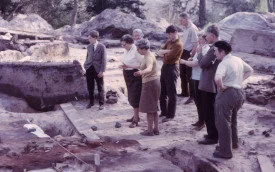
The total excavation of the cropmark enclosure at Braehead, Glasgow was commissioned by Capital Shopping Centres in response to an archaeological planning condition. As well as specifying a programme of public outreach during the excavation, the planning condition also required a full post-excavation programme through to publication of the results.
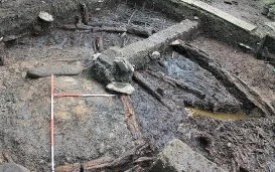
The Braehead enclosure is a rare survival of a prehistoric cropmark site in an urban setting. The excavation revealed a palimpsest of structural remnants - three large concentric ditches, at least four wooden palisades and the superimposed remnants of at least five roundhouses. Finds included pottery, some metalwork, a large assemblage of worked cannel coal fragments, stone and flint tools, while in situ waterlogged wooden posts and debris were recovered from the palisades and ditches.
The post-excavation analyses unravelled the chronological sequence of the structural remains, to determine the nature and function of the settlement. The soil samples were processed to retrieve artefactual material and organic materials, such as wood charcoal and plant macrofossils, which could be used for radiocarbon-dating. Through the analysis of the stratigraphic relationships between the structural remains it is clear that there were at least six phases of building activity, separated by periods of abandonment. Initially, the site consisted of a simple single palisade which was refurbished at least once. This was succeeded by a period of unenclosed settlement consisting of a single roundhouse. The settlement was once again enclosed, this time by three massive concentric ditches. The site was then abandoned and when it was re-used, a settlement enclosed by a number of palisades and containing at least one roundhouse was constructed. This settlement eventually went out of use and the final phase consisted of a number of roundhouses without any defensive perimeter. The radiocarbon dates demonstrate that all this activity occurred during the 1st millennium BC.

Analysis of the sediments in the ditches using soil micromorphology and diatom content helped us to understand the nature of the settlement at Braehead. It seems likely that the site may have been occupied only intermittently, perhaps seasonally. Certainly its location, on the tidal floodplain of the River Clyde would always have made occupation at certain times of the year very difficult. The rapid accumulation of, and the semi-permanency of ditch water, is attested by microlaminated ditch silts while the diatoms confirm the presence of brackish water in the ditch terminals. It therefore seems likely that for much of the winter and early spring the site was periodically flooded and waterlogged, and consequently treacherous to approach, at least on foot; in all, not a very pleasant place to inhabit.
This interpretation, of an intermittently occupied site, is supported by other evidence. There is no evidence for the processing of cereals on site, although carbonised wheat and barley were found. If the site was used for only relatively short durations, then it is possible that pre-prepared food stuffs were used, saving the trouble of bringing equipment such as quern stones, none of which were found on the site. The finds assemblage is, apart from one unusual category, relatively sparse, despite the fact that the entire site was excavated. Sherds from 12 pottery vessels, 21 stone tools, 2 flint tools, and 3 bits of metalwork were found. The exception was the substantial assemblage of roughouts and other debris associated with the manufacture of cannel coal bracelets, the largest such assemblage found in Scotland. All stages in the production of the roughouts are represented and in such quantities as to suggest that the semi-industrial production of roughouts was carried out in the Braehead enclosure.
The final interpretation of the low lying palisaded site is that it was not a permanent settlement but that it was the focus of activity during the late spring, summer and early autumn, perhaps for the grazing and breeding of cattle on the water meadows around the site. Ordinary domestic activities did not take place at the site but as there was ready access to local sources of cannel coal, time spent there was used to make roughouts for jewellery, which were then finished off at a permanent settlement elsewhere during the winter months.
The results of the post-excavation analyses have been drawn together and are to be published by the Society of Antiquaries of Scotland in their Proceedings, which will form the final stage in satisfying the requirements of the planning condition.