Conserving the Forteviot Dagger Burial

Conserving the Forteviot Dagger Burial

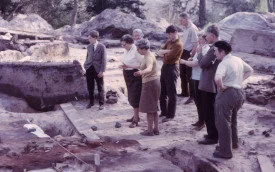
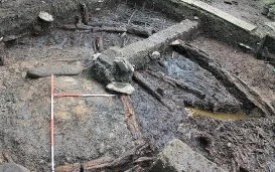
As part of the Historic Scotland Conservation Call Off Contract, AOC Conservators were involved in the Strathearn Environs and Royal Forteviot (SERF) project. During excavation a Bronze Age dagger burial was uncovered. The burial contained a knife, a firemaking kit and exceptionally well preserved organic remains.

An AOC conservator was called in and the objects – a complicated mixture of organic and inorganic objects - were carefully block lifted, wrapped and removed to cold storage. In addition to the ecofacts, the artefacts contained a total of 9 different types of material.

The first stage in the conservation process was to visually and chemically identify the materials present.  Visual techniques included, X-ray, close-up microscope workand CT scanning. A Scanning Electron microscope was used for visual and chemical identification, analysis of corrosion products and unknown materials. The information from the CT scan was invaluable in identifying materials prior to micro-excavation, and their inter-association with neighbouring artefacts. This was especially significant in the case of the firemaking kit, where pulling apart the various elements of the object would ultimately lead to potential loss of information on the use of the object and its wider role in the context of the cist.

This initial conservation programme allowed the material to be characterised and facilitated the design of an appropriate post excavation programme. As the initial characterization of materials was based on non invasive, non destructive techniques the various post excavation specialists could see the material in a state which was as close as possible to how it was when first lifted.

This has enabled the identification of elements never before identified in a cist of this age in Scotland such as the discovery of flower heads of meadowsweet amongst the organic material.

Download a poster detailing the work carried out by AOC conservators here