An Early Historic chapel & cemetery in East Lothian

An Early Historic chapel & cemetery in East Lothian

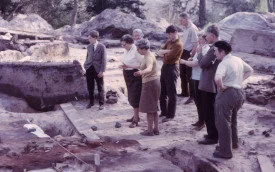
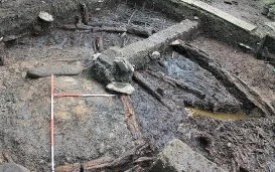
Following the discovery of human bone in a field located on a cliff top promontory on the East Lothian coast overlooking the Firth of Forth AOC Archaeology group were commissioned by Historic Scotland to investigate the site. The excavations recovered a large cemetery, the remains of a multiphase building presumed to be a chapel, a large ditch running across the promontory and a number of smaller ditches and gullies located around the periphery of the site.

Post-excavation work included a range of studies including analysis of: human remains; animal bones; shell; artefacts; and plant remains. This was complimenetd by a programme of radiocarbon dating.  This post-excavation programme was undertaken both by in-house AOC specialists and our associates including national experts from National Museums Scotland. This post-excavation programme of works revealed that the site was possibly one of the most important sites in East Lothian during the Early Historic period.

The site appears to have been in use from the 7th to the 17th centuries. Analysis of the shell suggests that the site had an industrial function producing Tyrean Purple dye used in ecclesiastical circles. There is also evidence to suggest that the site had strong monastic connections, most likely to the monastery of Baldred at Tyninghame in its early life from the 7th century through to the 11th century, the period of Anglo-Saxon occupation of East Lothian. This is shown by the large ditch which may be a monastic vellum and by the recovery of the only Anglo-Saxon glass inkwell found in Scotland, dientified by one of our associates. The Anglo-Saxon prescence is also shown by the gold and garnet stud and pins.

This period of relative prosperity probably came to an end in the tenth century following the destruction of Tyninghame by Olaf Godfreyson, or Amlaib son of Gothfrith, for a short while the Norse king of Northumbria in AD 941.  Radiocarbon dating of the skeletal remains show that the cemetery had an intermittent usage from the eleventh century and reflecting economic and social change in the area functioned as a small parish church and burial ground before been abandoned by the 17th century.  The general east-west alignment of the graves and the lack of grave goods indicate that this was a Christian burial ground.

The site is also note worthy as containing the only Viking grave known in south-east Scotland identified as such by accompanying grave goods which included horse equipment.

Although excavation was on a small-scale the importance of the site is reflected in the quality and rarity of the findings, illuminated through the detailed post-excavation programme, and has highlighted the great potential that the site has in adding to our understanding of the early medieval period not only from the recovered assemblages but as a resource for further investigation.